Showing posts with label EEG. Show all posts

Monday, September 19, 2016

3D Printing

I've been having some fun getting to know the 3D printers in Temple's College of Engineering. I've been using a StrataSys Objet 3D printer to create parts for EEG headsets for a hackathon we're running this weekend (more details on that soon). We've been using headset designs from OpenBCI. We bought the electronics from them and we're printing our own headsets. The first part of the print took some 60 hours but man are the parts nice. The parts come off the printer embedded in a flimsy scaffolding:


The scaffolding is manually removed using a pressure washer to strip it all away:


The finished products are firm and very cleanly articulated:


I'll post some pictures of the headsets once they're completely put together. Overall though, its a really neat process!

Wednesday, December 2, 2015

High Performance Computing Cluster

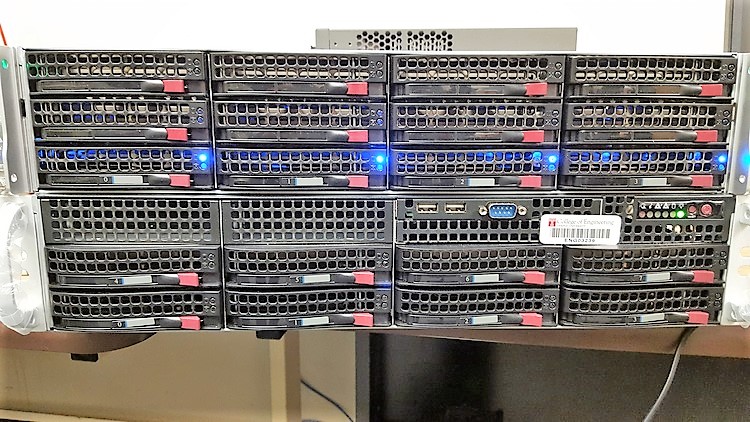
This past summer and fall, my research partners built our own personal high performance computing cluster. Temple has its own cluster (Owls Nest) but it's always in heavy use by others around the university and so we're always scrapping for resources. So we built our own cluster. First we built a testbed cluster by lashing together a handful of surplus PCs and then we used that to spec out a formal HPC cluster that we paid about $27k for out of a grant.

The cluster is pretty awesome. Our student, Devin Trejo, put together a very comprehensive blog post on how the cluster was designed and built. You can read all about it here:
http://www.tdevin.com/2015-11-30-hpc-batch-processing/

Friday, December 6, 2013

QED!!!

My partner Joe Picone and I were honored to be awarded a QED award from the University City Science Center to support the development of software for automatically tagging significant events in EEG readings. It was a very competitive process based as much on business potential as on technical merits, and we are thrilled to have been selected. Temple News has the scoop.

Thursday, February 7, 2013

Brain Game Technologies

Two interesting things I saw today regarding neural interfaces and computer games. First, an article from IEEE Spectrum about using neural and muscle recordings to predict how much people are enjoying playing a video game. If possible, it might help developers determine how well their multimillion dollar game development projects will pay off.

The second link is even more intriguing: the NIH is now advertising an request for SBIR proposals surrounding the combination of neural modulation and video games. Scientists have long known that neural modulation (learning to operantly condition various brain activity) can be a way of dealing with various conditions such as ADHD, but there has been relatively weak development in terms of computer games and graphics that would make such an interaction robust and enjoyable for the user. Now NIH appears ready to put some money into this venture. I'll be interested to see what gets funded.

Wednesday, May 23, 2012

Intracranial EEG

I learned about a fascinating technique today from an outstanding Temple med student: Intravascular EEG. The concept is based off the common cardiology technique of introducing a catheter into the body via a larger artery such as the femoral, and then traversing the vasculature to a target site in the body. In this EEG technique, the catheter is passed all the way through the body until it reaches the brain - the papers I'm looking at indicate it can be parked in any one of the larger sinuses in the brain such as the cavernous sinus or the superior petrosal sinus. The electrode can then be pressed against the sinus wall and an electrical recording can be made. In theory, this means that high fidelity signals can be recorded very close to the structures of the deep brain. Presently, the electrical function of such structures must be inferred indirectly by analyzing recordings made from the scalp surface.

Intracranial EEG appears to be a neat idea with a lot of potential research applications. Can you localize and characterize deep epileptic foci with more precision than via surface EEG? Can you assess traumatic brain injury (which typically affects the deep brain moreso than the surface tissue)? And can you stimulate structures of the deep brain in this manner?

Lots of food for thought!

Friday, August 19, 2011

Hilbert Transform

We are learning how to analyze EEG signals for a project we are working on regarding traumatic brain injury in rats. It seems that one of the best methods for analyzing phase in a signal is to look at the Hilbert Transform. I invested a good deal of time yesterday learning about this process and I was pretty impressed. The two videos below are lectures from the Indian Institute of Technology about the underlying math. I summarized the videos in a short set of notes which is linked here. I'll update again later once we have a better idea on how to apply this technique to EEG analysis.


Friday, August 12, 2011

Wednesday, May 4, 2011

Common Spatial Patterns

Congratulations to lab member Alessandro Napoli who presented a poster titled, "Combined Spatial Pattern and Spectral Filtering for EEG-Based BCIs" at last week's Conference on Neural Engineering in Cancun.

Alessandro is studying methods of de-noising EEG signals for brain machine interface applications. We now have an IRB in place to study his proposed technique in quite a few people, so hopefully his summer should be quite productive and we'll have some good results to publish come fall.

The technique he proposes combines Common Spatial Patterns (CSP) filtering with spectral analysis to look for areas of high activity in the brain during BMI tasks. His preliminary data is encouraging.

We are learning that acquiring high-quality EEG signals is as much art as it is science. We'll put together a blog post later this summer with some of our newly-acquired wisdom.

You can download the full-sized poster here.

EEG Headsets

A while ago I wrote about limitations in the EEG Headset market. I thought I might post an updated list of whats on the market these days. These are a combinations of products and research endeavors.

Developed for gaming - Lack signal integrity for actual EEG research
Emotiv
Neurosky

Prohibitively Expensive
IMEC Group: Dry electrodes, ASIC front end, 8 channels (not available for purchase, but ASICs are very expensive)
Quasar: Custom dry electrodes, up to 23 channels (recently quoted at $50k)

Not available for purchase
Advanced Brain Monitoring: 20 channels

Low Channel Count / Not available for purchase
Halifax Consciousness Scan: 3 channels
University of Sydney: Dry conductive silicone electrodes, 3 channels
Aalto Univ (Finland): 8 channels

Developed for NeuroMarketing; No published performance data / Not available for purchase
Neurofocus/Mynd

So there is without question a lot of interest in developing wireless ambulatory EEG, but it appears that no one has quite yet gotten a plug-and-play off-the-shelf system going for a somewhat reasonable price. Opportunity knocks?

Tuesday, May 3, 2011

Brain Controlled Angry Birds


Emotiv ... Hmmm. We've heard nothing but negative comments about the emotiv as a research tool. God knows how they got this working.

Wednesday, March 2, 2011

Brain Games

I came across this blog entry from IEEE Spectrum about a video game based on the $100 Mindwave headset from Neurosky. The reviewer is clearly impressed!

We are starting to investigate new techniques for creating wireless EEG headsets. The two leading companies in this area (Emotiv and Neurosky) have a reputation in the community for being insufficiently high-fidelity to suppor research grade recordings. The Emotiv only has a handful of channels and none of them are over brain regions correlated to motor planning or execution. The Neurosky (at least as of this writing) only has a single electrode over the forehead (FP1). Its not even clear that these devices are recording pure EEG - its more likely they record a combination of EEG and muscle artifacts.

In our lab, we've been trying to develop our own EEG-based brain computer interface system. For our first attempt, we used the Clevemed Bioradio to acquire EEG signals using an old EEG-cap we had lying around. The signal to noise ratio was a mess and we could barely get enough signal fidelity to move a cursor in one dimension. Since then we've upgraded to a higher quality EEG amplifier (a mint-condition 20-year old Grass Model 12 Amp with 22 channels that was donated to us by a very kind emeritus professor in Psych) as well as a snugger-fitting EEG cap. These two upgrades have improved the signal to noise ratio but we have persistent problems with the impedance between the electrodes and the scalp (the Model 12 allows us to measure the impedance). We are learning that even the world's nicest EEG amp won't do you much good if your electrode impedance is too high (say, greater than 10k Ohm).

Ultimately we'd like to design a research-grade wireless EEG system. Our biggest challenge (and one we feel hasn't been solved by either Emotiv of Neurosky) is to reduce the electrode/scalp impedance down to a more manageable level.

Happy gaming!